An LED aluminum profile is a metal housing designed to hold and protect LED strip lights while providing a cleaner appearance and helping with heat management and light diffusion. It is widely used in residential, commercial, retail, furniture, and architectural lighting projects.
Although LED aluminum profiles may look relatively simple, choosing the right one requires more than checking its external dimensions. The profile type, internal width, depth, aluminum construction, diffuser, surface finish, mounting method, LED strip compatibility, and installation environment can all affect the final lighting result.
For distributors, contractors, lighting designers, furniture manufacturers, and OEM customers, the choice becomes even more important because profile consistency and customization can directly affect project quality and production efficiency.
This complete buying guide explains what to look for when choosing an LED aluminum profile and how to select a profile that matches your lighting application.
What Is an LED Aluminum Profile?
An LED aluminum profile is an aluminum extrusion specifically designed to house LED strip lights.
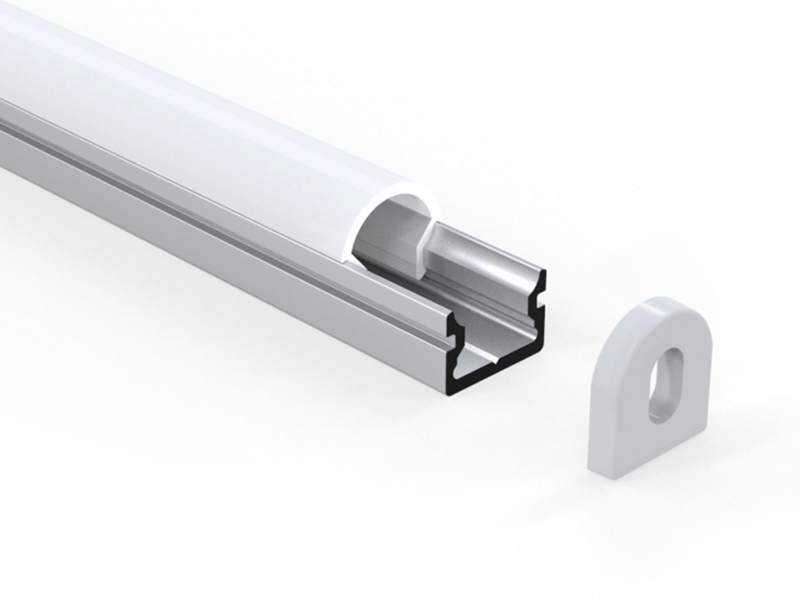
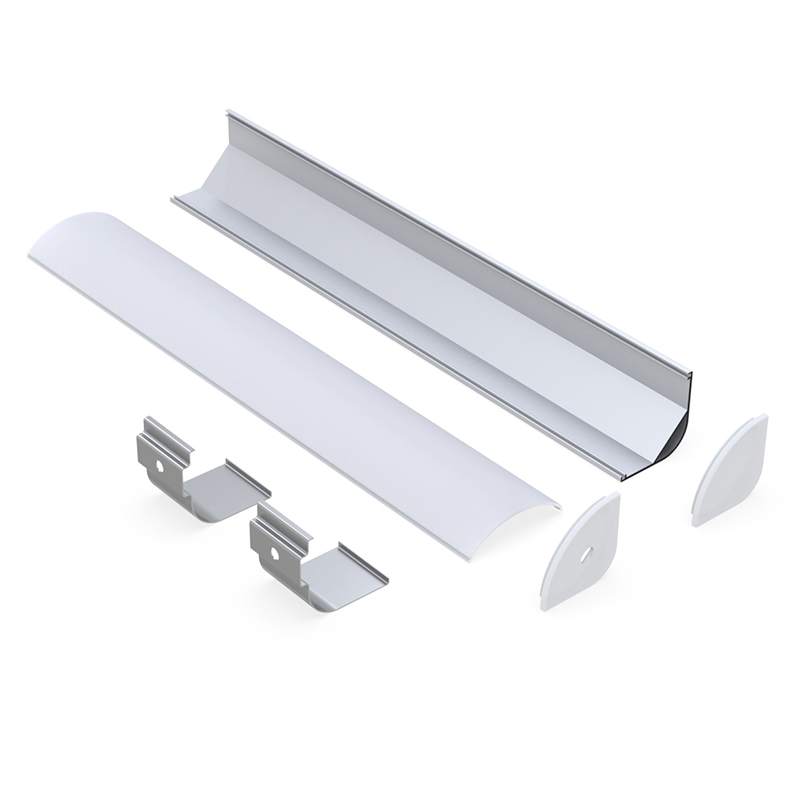
The basic system normally consists of an aluminum profile, LED strip, diffuser, and end caps. Depending on the design, mounting clips, brackets, screws, suspension kits, or other accessories may also be included.
The LED strip sits inside the profile, while the diffuser covers the light source. The aluminum body provides mechanical support and creates a more finished appearance.
A typical LED aluminum profile can provide several functions:
- Hold the LED strip securely
- Help transfer heat away from the LED strip
- Protect the strip from physical contact
- Diffuse and control the emitted light
- Hide wiring and strip components
- Create a cleaner architectural appearance
- Provide different mounting and installation options
The profile itself does not determine the performance of the entire lighting system. The LED strip, diffuser, power supply, installation environment, and profile design all work together.
Why Use an LED Aluminum Profile?
One of the main reasons to use an aluminum profile is to turn an exposed LED strip into a more integrated lighting system.
Heat Management
LED strips generate heat when operating. Aluminum has good thermal conductivity, so an aluminum profile can provide a path for transferring heat away from the LED strip.
However, it is important not to assume that any aluminum profile will automatically provide sufficient cooling. Thermal performance depends on factors such as LED strip wattage, profile dimensions, aluminum wall thickness, contact between the strip and profile, installation location, and airflow.
Higher-power LED strips may require a larger profile with greater thermal capacity.
Physical Protection
A profile can help protect an LED strip from accidental contact, dust, and mechanical damage.
The diffuser also provides an additional protective layer over the LEDs.
For furniture, retail displays, cabinets, and architectural installations where the strip may otherwise be exposed, this can be particularly useful.
Improved Appearance
A bare LED strip can look unfinished when installed on a visible surface.
An aluminum profile creates a straight, consistent housing that can be integrated into walls, ceilings, furniture, cabinets, shelves, and other structures.
Different surface finishes and diffuser colors can also be selected to match the surrounding design.
Better Light Diffusion
The diffuser can soften the light and reduce the visibility of individual LED points.
Depending on the LED strip and profile design, clear, frosted, or opal diffusers can produce different visual effects.
If a completely continuous light line is required, however, the diffuser should not be considered in isolation. LED density, strip construction, profile depth, and the distance between the LEDs and diffuser also affect uniformity.
What Are the Main Types of LED Aluminum Profiles?
There are many types of LED aluminum profiles because different installation positions require different mechanical designs.
Surface Mounted LED Profile
Surface-mounted profiles are attached directly to a wall, ceiling, cabinet, shelf, or other surface.
They are relatively easy to install and are commonly used for:
- Under cabinet lighting
- Wardrobe lighting
- Shelving
- Furniture
- Display cabinets
- Decorative linear lighting
They are a practical option when cutting a recessed groove is not desirable.
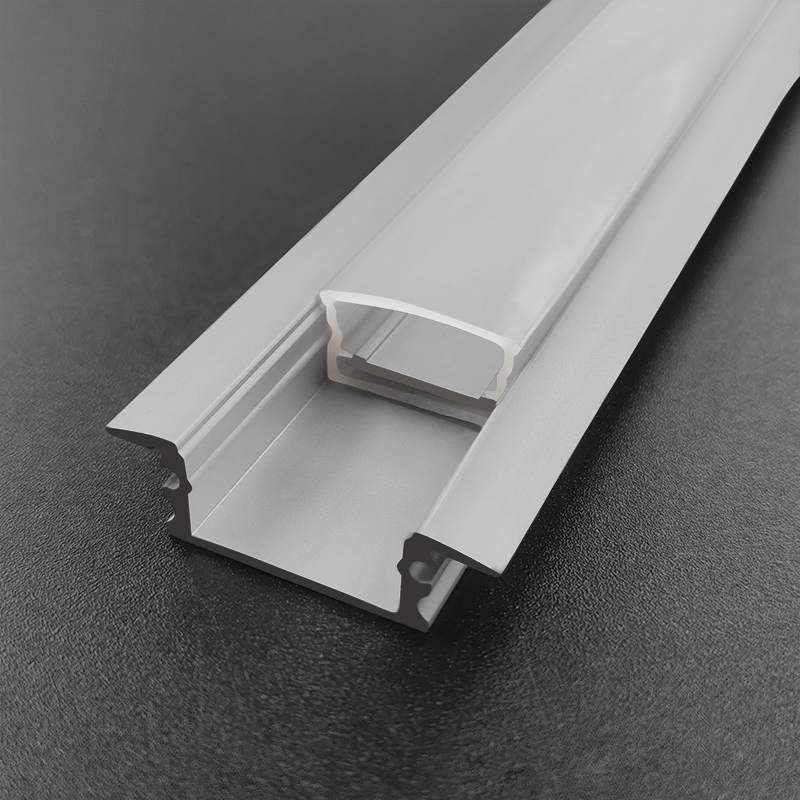
Recessed LED Profile
Recessed profiles are installed into a groove or opening in the mounting surface.
Once installed, much of the profile can be hidden, creating a more integrated appearance.
They are frequently used in furniture, ceilings, walls, cabinets, and architectural details.
The groove dimensions should be planned carefully because even small dimensional differences can make installation difficult.
Corner LED Profile
Corner profiles are designed for 90-degree or angled installation positions.
They are useful when the LED strip needs to illuminate toward a different direction rather than directly outward.
Typical applications include cabinet corners, shelves, furniture, and wall-to-ceiling junctions.
Suspended LED Profile
Suspended profiles are designed to hang from ceilings using suspension cables or other hardware.
They are commonly used for linear pendant lighting in commercial, hospitality, retail, and residential environments.
Some systems can be connected to create long continuous linear fixtures.
Plaster-In LED Profile
Plaster-in or trimless profiles are designed for integration into drywall or plaster surfaces.
A flange allows the surrounding surface to be finished against the profile, reducing the visible transition between the lighting fixture and the wall or ceiling.
These profiles are commonly used in architectural projects where a seamless appearance is important.
Floor and Stair LED Profile
Floor and stair profiles are designed for applications where the profile is installed at floor level, along steps, or in other locations subject to greater mechanical exposure.
The profile design, diffuser strength, mounting method, and environmental conditions should all be considered before selection.
Custom LED Aluminum Profile
Some projects cannot be completed efficiently using standard profiles.
Custom profiles can be designed around specific LED strip dimensions, installation structures, optical requirements, furniture components, or architectural designs.
For large B2B projects, custom extrusion can provide greater control over the final product.
How to Choose the Right LED Aluminum Profile
1. Check the LED Strip Width
The first specification to check is the width of the LED strip.
Common LED strip widths vary between products, so do not select a profile based only on its external width.
Instead, check the actual internal mounting width.
You should also consider the height of the LED strip and any components mounted on the PCB. Connectors and wiring may require additional space.
A profile that fits the strip itself may still be unsuitable if the diffuser cannot close properly or the connector does not fit inside the channel.
2. Choose the Correct Profile Depth
Profile depth affects both installation and lighting performance.
Shallow profiles are useful where installation space is limited, such as under cabinets or inside furniture.
Deeper profiles provide more space between the LED strip and diffuser, which can improve optical mixing and help reduce visible LED points when combined with an appropriate strip and diffuser.
The best depth therefore depends on both physical space and the desired lighting effect.
3. Consider the LED Strip Power
LED strip power is an important consideration for thermal management.
A low-power decorative strip may work well with a compact profile, while a high-power strip may require a larger aluminum profile with greater heat-dissipation capacity.
The installation environment also matters.
A profile installed openly on a metal surface will have different thermal conditions from one enclosed inside a cabinet or furniture structure.
4. Select the Right Diffuser
The diffuser is an important part of the lighting system.
Clear diffusers generally provide high light transmission but can make LED points more visible.
Frosted diffusers soften the light and help reduce the visibility of individual LEDs.
Opal or milky diffusers provide stronger diffusion and are often used when a smoother appearance is required.
The diffuser should be selected together with the LED strip and profile depth rather than independently.
5. Evaluate the Aluminum Construction
Not all aluminum profiles are identical.
For B2B applications, buyers should consider:
- Aluminum alloy
- Wall thickness
- Profile weight
- Dimensional accuracy
- Straightness
- Extrusion consistency
- Surface finish
- Batch-to-batch consistency
A profile with inconsistent dimensions can create problems during installation, especially when large quantities are being used in a continuous lighting project.
For visible architectural installations, surface quality is equally important because scratches, color differences, or inconsistent anodizing can become noticeable after installation.
What Surface Finishes Are Available?
LED aluminum profiles can be supplied with different finishes depending on the project requirements.
Common options include:
Anodized Aluminum
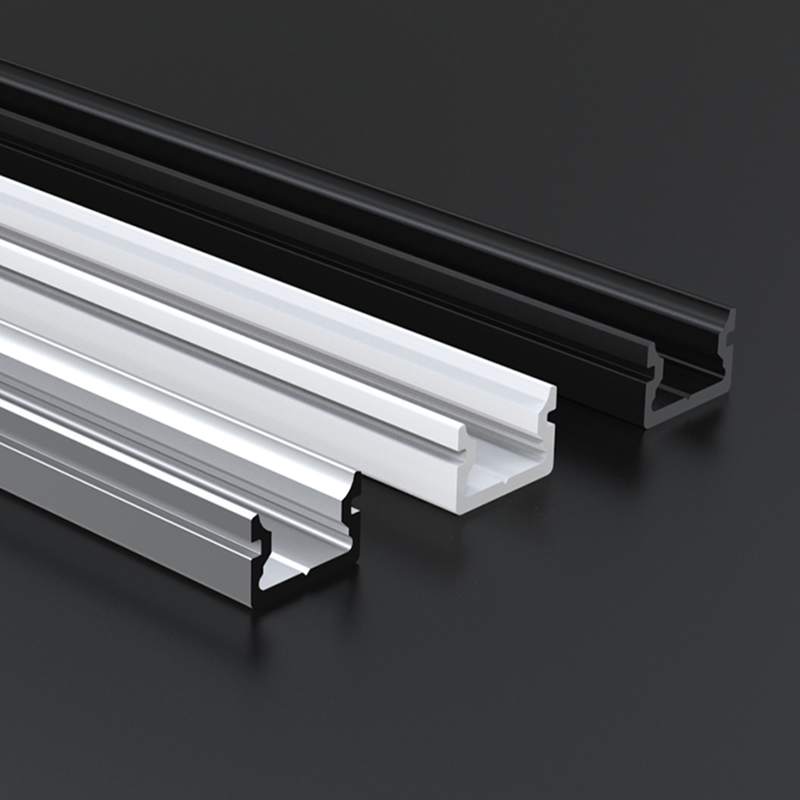
Anodizing provides a durable surface finish and is commonly used for silver or natural aluminum profiles.
Powder Coating
Powder coating allows manufacturers to produce profiles in a wide range of colors, including black and white.
This can be useful when the profile needs to match a particular interior or architectural design.
Custom Finishes
For OEM projects, customized colors or surface treatments may be developed according to project requirements.
When ordering large quantities, buyers should request production samples to confirm that the finish meets expectations before mass production.
What Accessories Do You Need?
Buying the aluminum profile alone may not be enough to complete the installation.
Depending on the profile design, accessories may include:
- Diffuser
- End caps
- Mounting clips
- Brackets
- Screws
- Suspension cables
- Connectors
- Gaskets or seals
It is useful to confirm the complete accessory list before ordering.
For B2B projects, compatibility between the profile, diffuser, end caps, and mounting hardware is particularly important because purchasing components separately from different suppliers can create dimensional problems.
How Do You Choose Between Surface and Recessed Profiles?
The choice mainly depends on the installation method and desired appearance.
A surface-mounted LED aluminum profile is generally easier to install and is suitable when the profile can remain visible.
A recessed profile provides a more integrated appearance but requires a suitable groove or opening in the mounting surface.
For new furniture or architectural projects, recessed installation can often be planned during manufacturing.
For retrofit applications, surface mounting may be more practical because it requires less modification to the existing structure.
Is an LED Aluminum Profile Waterproof?
An aluminum profile itself should not automatically be considered waterproof.
Water resistance depends on the design of the complete lighting system.
For applications exposed to moisture or outdoor conditions, factors such as the LED strip’s IP rating, diffuser design, end caps, seals, cable entry points, connectors, and installation method must all be considered.
A standard open aluminum profile with a normal diffuser is not necessarily suitable for outdoor or wet environments.
If waterproofing is required, ask the manufacturer whether the complete profile system has been designed and tested for the intended environment.
When Should You Buy a Custom LED Aluminum Profile?
Standard profiles are sufficient for many common applications, but custom extrusion becomes useful when the project requires specific dimensions or functions.
Custom LED aluminum profiles may be suitable when you need:
- A unique cross-sectional shape
- Specific internal dimensions
- A special LED strip width
- Custom mounting structures
- A particular light-emitting angle
- Furniture integration
- Customized diffuser geometry
- Special surface colors
- Long continuous linear lighting
- OEM branding and packaging
For large-volume projects, custom extrusion allows the profile to be designed around the lighting system instead of adapting the entire project to an existing standard profile.
What Should B2B Buyers Ask an LED Aluminum Profile Manufacturer?
Before placing a bulk order, distributors, contractors, lighting brands, and project buyers should confirm several technical and commercial details.
Ask the manufacturer about:
- Aluminum alloy and material specifications
- Internal and external profile dimensions
- Available profile lengths
- Compatible LED strip widths
- Maximum recommended LED strip power
- Diffuser material and optical options
- Available surface finishes and colors
- Mounting accessories
- Cutting and machining capabilities
- Custom extrusion tooling
- MOQ and tooling costs
- Sample availability
- Packaging and labeling options
- OEM/ODM capabilities
A supplier capable of handling extrusion, machining, finishing, diffuser production, and assembly can simplify the supply chain for larger lighting projects.
LED Aluminum Profile Manufacturing and OEM/ODM
For B2B customers, an LED aluminum profile manufacturer can provide more value than simply supplying standard extrusions.
A typical custom development process can include product design, CAD development, extrusion tooling, aluminum extrusion, precision cutting, CNC machining, surface finishing, diffuser customization, assembly, inspection, and packaging.
Baiwei Lighting’s LED linear profile manufacturing services cover product design, aluminum extrusion, CNC machining, surface finishing, diffuser customization, and final assembly.
This type of one-stop manufacturing capability can be particularly useful when developing a new lighting product or when a project requires a customized profile rather than an off-the-shelf solution.
Final Thoughts
Choosing the right LED aluminum profile involves much more than selecting a profile that fits an LED strip.
The most important factors include the LED strip width and power, profile depth, internal dimensions, aluminum construction, diffuser, surface finish, mounting method, thermal requirements, and installation environment.
For simple cabinet or furniture lighting, a compact surface-mounted profile may be sufficient. Architectural projects may require recessed, plaster-in, corner, suspended, floor, or custom profiles.
For B2B buyers, manufacturing capability should also be part of the evaluation. A reliable supplier should be able to maintain consistent extrusion quality while providing customization, machining, finishing, diffuser options, accessories, and OEM/ODM support.
By evaluating the LED aluminum profile as part of the complete lighting system, buyers can select a solution that balances appearance, installation requirements, thermal management, optical performance, and long-term project requirements.